






You are Invited
Please join us this Friday
October 18th * 9:00-11:00
OPEN HOUSE
 Coffee & Bagels
Park Place * Suite 207
Please stop in. This is our new home and we would love to meet our neighbors.
Posted in Real Estate For Sale
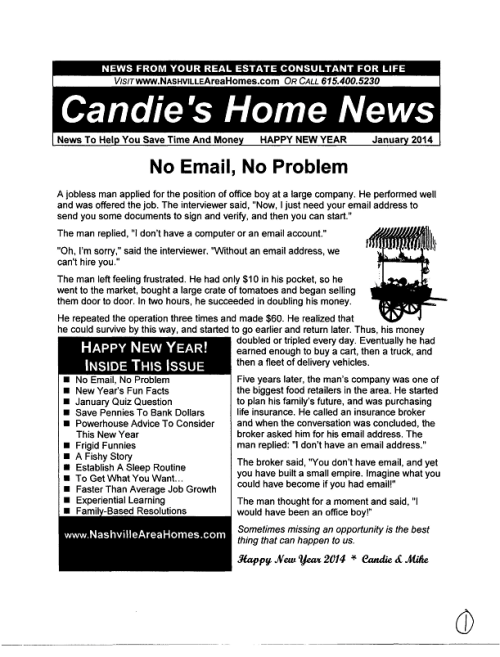
Value in Getting Ready for the Sale
Deciding to sell your house is never easy. Everywhere you look, you see memories…the stairs your daughter first climbed, the kitchen where your family used to gather before the kids moved out and the garage where you parked your first mini-van.
It is important to remember, though, that by moving, you are not giving up these memories—they will stay with your forever. You are simply selling the house—the bricks, the wood, the mortar–nothing you cannot find in another neighborhood.
That said, it is critical that you realize selling your house may involve some concessions on your part. For example, even if you want to receive X amount of dollars for your house, a buyer may want to pay less due to the house’s age or because of necessary remodeling.
You must be prepared for such concessions. Once you have decided to sell, it is next necessary for you to give your house an honest assessment.
Does your house need a paint job? A new roof? Take note of these things, as you may profit tremendously in preparing your house for sale. You get used to seeing things in your house and start accepting things because you know they’re good and working properly but a person looking to invest in your house wants the best look they can get for the buck.
As a first step, if you belong to a homeowner’s association, inform the directors that you are selling your house. Ask if there are any lawsuits or legal issues that concern the association, and obtain copies of any documentation.
Next, understand that having a house that is visually pleasing and technically sound will help it sell much faster. And, with a house that does not require many renovations or repairs; you are more likely to get your asking price. So, if you think inexpensive improvements can be done and you are willing to pay for them so your house value will increase, suggest these improvements.
Certainly, however, we will forewarn you—preparing your house for sale is a long process, requiring more than a little hard work (but it’s well worth it!). So, if you’re ready, let’s evaluate the outside of your house first.
Call Candie for more information on getting your home ready to sell. 615.400.5230
Posted in Real Estate For Sale
http://www.ShowcasePhotographers.com/sba/index.php?sbo=as1304161
Perfect 10 All Brick in Hermitage with Private lot and deck overlooking trees and nature! 3 beds/2.5 baths ready to move in. Minutes from Lake and Downtown Nashville! Price to sell at only $237,500!
How Sellers Price Their Homes
How Much Should I Offer?
Clients often ask, “How much under the listing price should we offer?”
The best way to understand market value is through comparative research. Professional real estate consultants review and study at least 40 to 60 listings, visit 10 to 20, and inspect 5 to10 properties to develop a sense of relative worth for properties in a given area.
Additionally, a professional appraisal factors into determining the fair market value of the home. An appraisal protects you because Lenders want to make sure that you don’t overpay for a home. If the home value does not meet the sale price in the eyes of the appraiser, they’ll let you know. At that time, the Realtor can renegotiate the sale price or void the agreement and refund your earnest money deposit.
There are four basic factors that influence how sellers price their homes.
1. Sellers Get Poor Advice
Some real estate agents inflate the value of the seller’s home in an effort to obtain the listing. There’s a natural tendency on the part of sellers to list with the real estate agent who gives them the promise of the highest selling price. When homes are overpriced, they stay on the market longer & may not sell
These sellers believe their home is worth every penny of their asking price for personal reasons. Sometimes they lose their objectivity and focus on features that seem more valuable to them (rather than to the buyer). For example, the suede wall-covering in the master bedroom may not appeal to potential buyers. Additionally, some sellers, anticipating reticence to buy, feel it’s a good idea to leave a little “negotiating” room in the asking price.
3. Sellers Price their Home at Fair Market Value
These sellers carefully and realistically study other homes for sale, and may consult with a real estate professional. They price their home competitively, and it usually sells quickly at (or very near) the asking price.
4. Sellers are Motivated to Sell
When sellers want a fast sale, they price their home below fair market value. These homes usually sell right away, at or above the listed price. There are usually competing offers.
Posted in Real Estate For Sale
How To Lose Your House………………………..
Between the speculation and pricing madness during real estate booms, people actually buy houses so they can live long, happy lives there.
But home buyers should know — particularly if one of your goals in buying a house is achieving a more stable lifestyle for yourself and your family — that losing a house is a fairly easy thing to do. Here are five common ways people lose their houses.
1. Start Off With Bad Mortgage Terms
Most people focus on the price they pay when they buy a house, but the reality is that the most expensive part of buying a house is the interest on the mortgage. Even a fraction of a percentage makes a big difference on your monthly payments, and could mean tens of thousands of dollars over the life of the loan.
But just as it’s easy to focus on the price of the house, it’s also easy to get caught up with the interest rate on the mortgage. The terms of the loan are what really determine how much your mortgage ends up costing you.
The interest rate isn’t the rate you pay; it’s one of many charges that get rolled into your Annual Percentage Rate (APR), the actual rate you pay per year. The APR will almost always be higher than your interest rate because of added fees.
Your lender is required by the Truth-in-Lending Act to breakdown the fees and tell you what the APR is. Please don’t ignore the Truth-in-Lending disclosure — you do so at your peril.
Key phrases you should ask about that signal potentially dangerous mortgage terms include: pre-payment penalty, partial amortization, negative amortization, option ARM, and sub-prime.
Phrases that signal mortgages that require extra care include: teaser rate, adjustable rate mortgage (ARM as opposed to option ARM) and interest-only payments. These are not inherently bad, but require vigilance because the rate you locked-in will change, and possibly increase significantly.
2. “Keeping Up With The Joneses”
Sometimes people who live in expensive neighborhoods and have fancy cars aren’t the ones with the most money — they’re just the ones who spend the most. This material arms race has caused more than one person to become so riddled with debt that they hurt the successful lifestyle they were originally trying to achieve.
Buying too big a house is a fast way of digging yourself into unmaintainable debt and causing unnecessary stress on you and your family. Financial strain leads to emotional strain and large houses often require a lot of furniture, all of which has to match the level of the house. This leads to expensive credit card debt, which hurts your ability to pay your mortgage debt.
And, also, while some people are tempted to buy a more expensive house than they need because of a good school district, you may be able to save money by getting a home in a less expensive neighborhood and sending your kids to quality private schools.
3. Failing to Communicate with Your Lenders
Even if you have fallen into a bad situation and cannot pay your mortgage, you still have the opportunity to save your house. Most make other arrangements.
But you can’t make those arrangements if you don’t tell your lender what’s going on. Maybe you’ve had unforeseen circumstances at your job or have had large medical payments recently. Or maybe you’re having trouble making your payments because of too much debt.
While lenders might not be described as “understanding,” you can negotiate with them by understanding their goals. Lenders aren’t in the business of buying and selling real estate. If they foreclose on your property, they will probably lose money on the deal and go through a lot of inconvenience as a bonus.
Knowing this and assuming you are dealing in good faith, your lender may offer you debt consolidation, a deferred payment plan, or another solution to avoid a larger loss for them.
If you run into a situation where you cannot pay your mortgage, for any reason, do not abandon the house: read The Department of Housing and Urban Development (HUD) advice on the topic, tell your lender immediately, and enlist the advice of a reputable, non-profit credit counseling service. Using a non-profit is organization is key because you run a very high risk of being scammed at this stage.
4. Mess With the Government and Its Money
There’s probably no more efficient way to lose your house than to fail to pay your property taxes. The government doesn’t kid around and they make sure your debt to the government takes precedence over any other debt you have. If you cannot pay your property taxes, you need to notify the government immediately.
Even if you think the tax bill is incorrect, “Pay Property Taxes First, Dispute Later.” Separately, keeping an impound account as a discipline to help you save money for taxes and insurance. The bottom line is that as serious as lenders may seem about getting their money, the government will almost always get its way first.
5. Buy Too Little Insurance
Nothing causes dire financial consequences like the unexpected. Fortunately, insurance companies make their living off preparing for unexpected financial consequences. The challenge is that insurance is one of those services people don’t want to think about because they don’t want to have to use it — which defeats its purpose. After all, it’s insurance.
But if you have a fire, or a burglary, or a flood, or an earthquake, and you are on the high-end of your debt-to-income ratio, you run the great risk of losing your house altogether because of the financial ramifications.
Some lenders will require you to get homeowners insurance but, often, standard insurance does not cover acts of God like floods and earthquakes. Moreover, while most policies cover your personal property (like your furniture, etc.), you need to take a strong home inventory including detailed lists and pictures, then store that inventory in a safe place or remote location.
Posted in Real Estate For Sale
Good News for Tennessee.
Did you know the overall tax burden people face in Tennessee is among the lowest in the nation as a percent of income.
So says a new study by the Tax Foundation, a Washington, D.C.-based think tank that researches tax and budget issues. The group’s conclusions offer a helpful gaze into the debate over what amount of taxation strikes the right economic balance.
The group released a study today calculating the total tax burden residents pay to state and local governments, with Tennessee ranking third lowest, behind only Alaska and South Dakota. Tennessee’s taxes as a percentage of income came out to 7.7 percent. New York was highest with 12.8 percent, and Alaska had the lowest with 7 percent.
With rates historically low now is the time to make that move to Tennessee! Call me for the lowest rates and best buys in Middle Tennessee! Call Candie Worsham Broker Direct 615.400.5230 or email me Candie@Worsham.com
Posted in Real Estate For Sale


 Nashville Area Homes